I want to give you a link to an article, but a subscription is required to read it on the interwebs. I found it in a book, The Best American Science and Nature Writing of 2007, and (unlike most of the drivel in the book) this article lives up to billing.
It's entitled "The Olfactory Lives of Primates", and it has some trivia in it that are not so trivial. For example, you might not have known that men (yes, human men) are attracted, albeit subconsciously, to ovulating women... more specifically, to the armpit-sweat of ovulating women. Gross and true.
Even cooler: in the middle of the 20th century, neurologists were trying to figure out which part of the brain does what. One group found that an interconnected network of small regions (amygdala, hippocampus, hypothalamus, etc) is vital to mammals' sense of smell, so they named it the rhinencephalon - literally, "nose brain". Another group, however, designed their study differently, finding that the same network is responsible for the emotions.
Which is it? Smells or emotions? The answer is "yes".
Your sense of smell is inexorably linked to your emotions.
Does anyone else suddenly have the overwhelming desire to pop a breath-mint?
Sapolsky, R. "The Olfactory Lives of Primates". Virginia Quarterly Review. Spring 2006, p86-90.
Wednesday, December 12, 2007

Monday, December 10, 2007
With apologies to cartoonists everywhere
the following is a purely fictional account of what might foreseeably happen to one of my grad friends...


Sunday, December 09, 2007
My Brother, My Muse
Every artist has his favorite medium. For Michaelangelo, I think it was marble, maybe. For Raphael, it was probably paint, I guess. I know for sure that Donatello definitely favored the bo-staff.
While I'm obviously a big fan of the written word, perhaps my most inspired work has been with a camera. More specifically, it has been photography of my younger brother, who will likely hate me after seeing this post. That's a risk I'm willing to take.
Just as the artist has his medium, the model has his Look. You may recall Zoolander's Blue Steel. Well, my brother's Look puts Blue Steel, Le Tigre, and even Magnum to shame.
My brother's look transcends naming, but if I had to give it a title, it would probably "Shove That Camera Up Your Ass", or STCUYA for somewhat-short.
Even in its earliest incarnations, STCUYA was an instant classic. Full of passion and fratricidal rage, it has the power to freeze me in my tracks to this very day. Back then, it lacked the discipline that would refine later versions of the Look, but it was still a doozie.
Over time, STCUYA evolved into a sophisticated, multi-layered Look. It still clearly expresses exactly what my brother wants me to do with my camera, but by drawing back slightly, he's added a subtle flavor of intrigue. This was a boy who did not want to be interrupted while reading the TV Guide.
I'm glad to report that I haven't lost my touch, nor has my brother. At Thanksgiving a few weeks ago, STCUYA made its most recent appearance over dinner. The indignation is plainly written on his face, but now it's so inconspicuous, so understated, as to be poetic.
STCUYA has progressed from a glared warning of my impending doom in a flurry of tiny child-fists to a profound insinuation of intense distaste. Eyes that once screamed STCUYA now simply whisper it. It is the very definition of art.
I'll take my Pulitzer now, thank you.
While I'm obviously a big fan of the written word, perhaps my most inspired work has been with a camera. More specifically, it has been photography of my younger brother, who will likely hate me after seeing this post. That's a risk I'm willing to take.
Just as the artist has his medium, the model has his Look. You may recall Zoolander's Blue Steel. Well, my brother's Look puts Blue Steel, Le Tigre, and even Magnum to shame.
My brother's look transcends naming, but if I had to give it a title, it would probably "Shove That Camera Up Your Ass", or STCUYA for somewhat-short.
Even in its earliest incarnations, STCUYA was an instant classic. Full of passion and fratricidal rage, it has the power to freeze me in my tracks to this very day. Back then, it lacked the discipline that would refine later versions of the Look, but it was still a doozie.

Over time, STCUYA evolved into a sophisticated, multi-layered Look. It still clearly expresses exactly what my brother wants me to do with my camera, but by drawing back slightly, he's added a subtle flavor of intrigue. This was a boy who did not want to be interrupted while reading the TV Guide.

I'm glad to report that I haven't lost my touch, nor has my brother. At Thanksgiving a few weeks ago, STCUYA made its most recent appearance over dinner. The indignation is plainly written on his face, but now it's so inconspicuous, so understated, as to be poetic.

STCUYA has progressed from a glared warning of my impending doom in a flurry of tiny child-fists to a profound insinuation of intense distaste. Eyes that once screamed STCUYA now simply whisper it. It is the very definition of art.
I'll take my Pulitzer now, thank you.
Saturday, December 08, 2007
In Support of Creationism
What's great is that just now, while reading the title of this post, my roommate Will had a mild heart attack. I'm sure he'll be fine, don't even worry about it.
First, some facts: The universe is more than a few thousand years old. Dinosaur bones were not planted by god to test our faith. We are related to monkeys. Okay, moving on...
Because the book is in Will's room, and Will isn't yet awake, I'll have to paraphrase something written by Richard Dawkins. He said something along the lines of "before Darwin, anyone who was an atheist wasn't paying attention". This implies, much like his books explicitly profess, that religion is inherently antiquated.
While I am inclined - and raised, and taught - to agree with Dawkins, I have to begrudgingly temper that with a concession to spirituality. Recognizing that it is, in fact, possible to believe in some higher power while simultaneously accepting scientific explanations for natural phenomena, I can't help but look at anatomy and physiology with a sense of wonder, a sentiment that can easily translate to faith.
The most macroscopic example I can think of is pennation, or the way muscles attach to tendons at an angle in order to increase their force production. Discussing this phenomenon in an Engineering class, it's inevitable to use words like "design", as in "the fiber arrangement in the calf is designed to maximize the force through the tendon". Note that this is grammatically comparable to, but conceptually independent of, something like "the arrangement is Intelligently Designed".
Then there is the ever-popular controversy over the origins of bacterial flagella. I despise the claim that the structure of the flagellum is "irreducibly complex", which asserts that there is no way something so utterly dependent on each of its constituent proteins could have evolved over time. People still stubbornly make this assertion, despite the overwhelming evidence to the contrary.
 If the existence of such contrary evidence will inherently lead to the undermining of their faith, then it isn't surprising that they're ignoring it. That said, you have to appreciate the beauty of this incredibly complex mechanism, which has been called "the world's most efficient motor". Yeah, that's right, you have to. Do it.
Or, if that doesn't do it for you, we can look a little deeper, at the membranes of mitochondria, where there exists another rotary complex of proteins. This structure is fueled by the flow of protons, and as it rotates, it drives a cam-shaft that re-energizes your ATP. Even if most of that sentence didn't make sense, it's worth repeating one part: there is a freaking cam-shaft, just like the one in your car, only this one's made of protein and is a few thousand times smaller and a few hundred thousand millenia older.
It boggles the mind, even at a glance... this, I think, is part of the reason that Creationism is so palatable to people. And here's another spin on it, an animation of cellular processes from the good folks at Harvard:
My favorite bit is at 1:17. I know you hate watching youtube videos, but indulge me on this one. We humans are fantastically good at anthropomorphizing what we see, and this little protein is no exception. What we're looking at is a molecule driven by chemical gradients and ATP dephosphorylation along an actin skeleton, the completely unconscious behavior of an automaton; what we see, though, is an animal trudging along a path, struggling to tow a massive load.
Unimaginably complex systems like this make it somewhat easy for me to put myself in the shoes of Creationsists - excuse me, Design Proponents. Like sequined, high-heeled galoshes, I think the shoes are ridiculous, but I have put myself in them just to see how they feel. Shouldn't it be even easier, though, to accept the scientific explanations - the theories that are rigorously tested, revised, and instantiated methodically?
One last thought. Creationists seem to have a big problem with the idea that life happened spontaneously, that the organic could be derived from the inorganic. While the window for that event was hundreds of millions of years wide, it was (at least intuitively) a low-probability event. The idea that life started by chance, that rather than being made in god's image we were the result of probabilities and mutations, must impart a sense of fragility.
Nobody likes feeling fragile.
First, some facts: The universe is more than a few thousand years old. Dinosaur bones were not planted by god to test our faith. We are related to monkeys. Okay, moving on...
Because the book is in Will's room, and Will isn't yet awake, I'll have to paraphrase something written by Richard Dawkins. He said something along the lines of "before Darwin, anyone who was an atheist wasn't paying attention". This implies, much like his books explicitly profess, that religion is inherently antiquated.
While I am inclined - and raised, and taught - to agree with Dawkins, I have to begrudgingly temper that with a concession to spirituality. Recognizing that it is, in fact, possible to believe in some higher power while simultaneously accepting scientific explanations for natural phenomena, I can't help but look at anatomy and physiology with a sense of wonder, a sentiment that can easily translate to faith.
The most macroscopic example I can think of is pennation, or the way muscles attach to tendons at an angle in order to increase their force production. Discussing this phenomenon in an Engineering class, it's inevitable to use words like "design", as in "the fiber arrangement in the calf is designed to maximize the force through the tendon". Note that this is grammatically comparable to, but conceptually independent of, something like "the arrangement is Intelligently Designed".
Then there is the ever-popular controversy over the origins of bacterial flagella. I despise the claim that the structure of the flagellum is "irreducibly complex", which asserts that there is no way something so utterly dependent on each of its constituent proteins could have evolved over time. People still stubbornly make this assertion, despite the overwhelming evidence to the contrary.
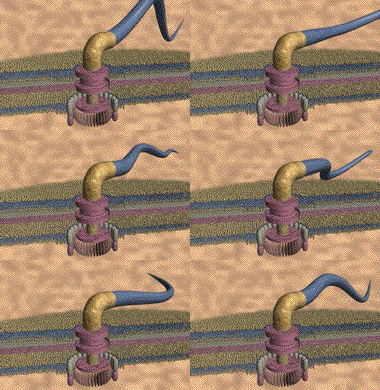 If the existence of such contrary evidence will inherently lead to the undermining of their faith, then it isn't surprising that they're ignoring it. That said, you have to appreciate the beauty of this incredibly complex mechanism, which has been called "the world's most efficient motor". Yeah, that's right, you have to. Do it.
Or, if that doesn't do it for you, we can look a little deeper, at the membranes of mitochondria, where there exists another rotary complex of proteins. This structure is fueled by the flow of protons, and as it rotates, it drives a cam-shaft that re-energizes your ATP. Even if most of that sentence didn't make sense, it's worth repeating one part: there is a freaking cam-shaft, just like the one in your car, only this one's made of protein and is a few thousand times smaller and a few hundred thousand millenia older.
It boggles the mind, even at a glance... this, I think, is part of the reason that Creationism is so palatable to people. And here's another spin on it, an animation of cellular processes from the good folks at Harvard:
My favorite bit is at 1:17. I know you hate watching youtube videos, but indulge me on this one. We humans are fantastically good at anthropomorphizing what we see, and this little protein is no exception. What we're looking at is a molecule driven by chemical gradients and ATP dephosphorylation along an actin skeleton, the completely unconscious behavior of an automaton; what we see, though, is an animal trudging along a path, struggling to tow a massive load.
Unimaginably complex systems like this make it somewhat easy for me to put myself in the shoes of Creationsists - excuse me, Design Proponents. Like sequined, high-heeled galoshes, I think the shoes are ridiculous, but I have put myself in them just to see how they feel. Shouldn't it be even easier, though, to accept the scientific explanations - the theories that are rigorously tested, revised, and instantiated methodically?
One last thought. Creationists seem to have a big problem with the idea that life happened spontaneously, that the organic could be derived from the inorganic. While the window for that event was hundreds of millions of years wide, it was (at least intuitively) a low-probability event. The idea that life started by chance, that rather than being made in god's image we were the result of probabilities and mutations, must impart a sense of fragility.
Nobody likes feeling fragile.
Friday, December 07, 2007
Please refund that hour of my life
There's no question that I am the best thing to happen to Academia since the free pre-seminar donut binge. You know it, and I know it, but do my future employers know it? With all of these big things happening in the lab, I'm still trying to keep my eye on the prize: a post-doc appointment, a professorship, tenure, and a hot-air balloon ride over the Grand Canyon.
As part of their never-ending endeavor to justify their own existence, the "TA Project" organized a panel session today. A couple of tenured professors from the sciences gave short lectures and answered audience questions about what to expect during the "Job Talk". When I saw the announcement, I thought, 'wow, the TA Project did something useful!'
They did not.
Almost immediately, what should have been a description of "how to get a job in academics" turned into a rudimentary explanation of how to give a presentation. The main points included such gems as:

A discussion of the "Job Talk", however, is no place for these sort of basics. I learned that stuff in 7th grade (thanks, Mr. Nieskens!), for crying out loud.
Surely there are other tips about the Job Talk that could have been discussed. Surely there are hints that are specific to getting a job in Academia. I'd give some examples, but I don't know any... that's the reason I was in the audience in the first place! Anyway, after sitting through an hour-long list of the common pitfalls of Powerpoint use, I officially learned nothing.
In fact, I may have actually gotten dumber. Among the advice we were given was the following: the second slide should be an outline of the presentation, to give the audience an idea of what to expect.
I don't know about you, but I have suffered through way too many terrible presentations, and a common thread among all of them was a slide that looked something like this:

I will never get that hour back.
As part of their never-ending endeavor to justify their own existence, the "TA Project" organized a panel session today. A couple of tenured professors from the sciences gave short lectures and answered audience questions about what to expect during the "Job Talk". When I saw the announcement, I thought, 'wow, the TA Project did something useful!'
They did not.
Almost immediately, what should have been a description of "how to get a job in academics" turned into a rudimentary explanation of how to give a presentation. The main points included such gems as:
- Don't read directly off your slide
- Don't read from a script
- Use citations when appropriate
- Tailor your presentation to the audience

A discussion of the "Job Talk", however, is no place for these sort of basics. I learned that stuff in 7th grade (thanks, Mr. Nieskens!), for crying out loud.
Surely there are other tips about the Job Talk that could have been discussed. Surely there are hints that are specific to getting a job in Academia. I'd give some examples, but I don't know any... that's the reason I was in the audience in the first place! Anyway, after sitting through an hour-long list of the common pitfalls of Powerpoint use, I officially learned nothing.
In fact, I may have actually gotten dumber. Among the advice we were given was the following: the second slide should be an outline of the presentation, to give the audience an idea of what to expect.
I don't know about you, but I have suffered through way too many terrible presentations, and a common thread among all of them was a slide that looked something like this:

I will never get that hour back.
Thursday, December 06, 2007
Red Berets
Ladies and Gentlemen, I am pleased to present to you this winter's hottest trend for grad student cyclists: Red Beret Training. With the off-season fast approaching, you might think that this idea was inspired by CSC's ludicrous training camps. Equally plausible is the possibility that I'm gearing up for Survivor 42: Donaldson Park.
In reality, this is but an homage to my good friend GI Mark, who is only 8 days from finishing Boot Camp at Ft. Benning.
Like Mark, participants in Red Beret Training will navigate treacherous Obstacle Courses. After a vigorous tire-sprint...

...you'll have to go under...

...and over...
 ...the trickiest obstacles known to grad-kind.
You'll learn camouflage, the art of blending into the jungle like the mutant offspring of monkeys and ninjas.

However, in this modern age of Urban Dorm Warfare, you'll need to disappear in a lecture hall as easily as in a rainforest. That's why our staff includes ex-CIA spooks, to make you a master of disguise.

You'll be taught markmanship, of course...

...but we'll also teach you to work in close quarters. By the end of Red Beret Training, you'll be able to kill a man with a dull #2 pencil, a graphing calculator, a stick of chewing gum, or your bare hands.

Sign up now. The first hundred registrants will receive a complementary Veyron. No fat chicks need apply.
In reality, this is but an homage to my good friend GI Mark, who is only 8 days from finishing Boot Camp at Ft. Benning.
Like Mark, participants in Red Beret Training will navigate treacherous Obstacle Courses. After a vigorous tire-sprint...

...you'll have to go under...

...and over...
 ...the trickiest obstacles known to grad-kind.
You'll learn camouflage, the art of blending into the jungle like the mutant offspring of monkeys and ninjas.

However, in this modern age of Urban Dorm Warfare, you'll need to disappear in a lecture hall as easily as in a rainforest. That's why our staff includes ex-CIA spooks, to make you a master of disguise.

You'll be taught markmanship, of course...

...but we'll also teach you to work in close quarters. By the end of Red Beret Training, you'll be able to kill a man with a dull #2 pencil, a graphing calculator, a stick of chewing gum, or your bare hands.

Sign up now. The first hundred registrants will receive a complementary Veyron. No fat chicks need apply.
Wednesday, December 05, 2007


Tuesday, December 04, 2007
Plasticity and Elasticity
First, I'm going to have to define terms. Elasticity is springiness - a paperclip holds papers because it resists deformation and wants to return to its original shape. Plasticity, on the other hand, is the capacity to undergo long-lasting change - under enough stress, the paperclip can be permanently reshaped.
Okay, here's the post:
Plasticity or Why I'm not afraid to race That Guy from That Team
If you've been doing the 4/5 races in Central or Southern Jersey, you know exactly who I'm talking about. I'm not going to call him out by name, or even by team - I try to hold myself to higher standards. But yes, he is That Guy.
People hate riding near him. He can't pedal smoothly, and the jerky trajectory that is the result makes him utterly unpredictable. In bike racing, as in driving, as in anything social, predictability is the keystone of safety. Wherever That Guy is in the pack, there's always a wide buffer around him. Nobody wants to ride near That Guy, because you never know when he'll suddenly move six inches to the side. I have, on more than one occasion, stuck my nose into a wicked headwind rather than draft off him.
There are many such timebombs in Cat 5 racing. C'est la guerre, I suppose. I like to call it Schrödinger's Crit; when racing a Cat 5 event, you are immersed in the near-inevitability of being crashed by such an idiot - you are simultaneously racing and bleeding in a ditch - and it isn't until your race is over that you can know if you've been crashed or not.

The guy I'm talking about - That Guy on That Team - is a special case, though. Rumor has it that somewhat recently, he was shot in the torso, and the bullet did damage to his spinal column. Obviously, the spinal cord wasn't completely transected, or he'd be a paraplegic. It is clear, however, that the damage has affected his motor control system.
As I said, I'm not afraid of That Guy on That Team. He's not some jerk who's too selfish to learn how to pedal. On the contrary, he actually just can't pedal smoothly. The Cat 5 jerks simply need to spend time riding, and their "muscle memory", the neural plasticity at the lower levels of control, will retain the ability to activate the muscles in the way that is proper - in other words, enough time in the saddle will make them smoother riders. That Guy on That Team, on the other hand, has suffered damage that interferes with lower-level control.
Fortunately, his mind is made of brains, and brains are brilliantly adaptive. I've already touched on this in the visual system, but the motor system is a little trickier. The best example of this is rehabilitation after stroke - if someone suffers damage to the right side, the right side's responsibilities can be transferred to the left. We know this happens because if a second stroke damages the left side, then all of the functional gains that had been made between strokes will disappear. Like a commuter stuck at rush-hour, That Guy's brain just needs to find a way to bypass the damage.
Easier said than done, but I have faith. For one thing, the adaptive process is accelerated by feedback, such as the twitchiness of a bike ride. Moreover, by next summer, I'll have earned another upgrade and will no longer need to race him ever again.
Elasticity or I hate to see you go but I love to watch you walk away
The way people move has always fascinated me. Consider the quarterback; I sure as hell can't throw as accurately, as far, or as fast, but I can appreciate the difference between Tom Brady and Jeff Garcia. Running gives an even easier example; it is absolutely enthralling to watch Paula Radcliffe break every biomechanical rule in the book as she wins yet another marathon. You just have to know what you're looking for.
It comes as a surprise to many novice biomechanicists that the best way to study motor control is to interfere with it. It makes sense, though... there's only so much you can do with the knowledge of how the average person walks, throws a dart, or whatever. To get any insight into the underlying mechanisms, you have to tease away the familiar.
Why are we so impressed by the "and one" in basketball, when a shooter makes the basket even after being fouled? It's because we know how hard it is to perform motor tasks accurately when some external force has interfered with the normal progression of things. Science can quantify the profundity of these effects, but we know intuitively that perturbations screw with our motor control systems.
While most of my research deals with the arms, I cut my teeth on motor control in the lower extremities, and my athletic leanings are pretty obvious too. What can I say, I'm a fan of the legs. We usually take walking for granted, but there is beauty and elegance to be found if you just look for it.
The supermodel walk. Their long legs cross-over each other, which does crazy things to their hip trajectories. It is a wholly unnatural walk, but I could watch it for hours.
Imagine a woman in high heels walking on a flat surface. Suddenly, her heel drops below ground-level... she's stepped in a pot hole. It's safe to say that she won't fall (if she does, though, feel free to laugh), but the way her body compensates for this sudden dynamical change - the extension of the swing-leg, the stiffening (hehe, yeah) of the stance-leg's joints, the slapstick flailing the arms - reflects the mysterious neural circuitry that feeds the "something is awry!" message into her brain.
It's hard to observe someone's reaction to that sort of obstacle outside of a lab setting, mostly because it's as surprising to the observer as it is to the walker. That's why I'm much more fascinated by the act of walking with an asymmetrical load. Imagine a woman walking with a heavy purse. The hips jut out towards the load, the shoulders lean in the opposite direction, and the gait pattern loses its symmetry and timing... she's never in danger of toppling over, but she's not designed to walk this way, and there is no "right" compensatory approach.
In conclusion, if you see me staring at a girl, please assume that I'm observing her biomechanics rather than leching.
Okay, here's the post:
Plasticity or Why I'm not afraid to race That Guy from That Team
If you've been doing the 4/5 races in Central or Southern Jersey, you know exactly who I'm talking about. I'm not going to call him out by name, or even by team - I try to hold myself to higher standards. But yes, he is That Guy.
People hate riding near him. He can't pedal smoothly, and the jerky trajectory that is the result makes him utterly unpredictable. In bike racing, as in driving, as in anything social, predictability is the keystone of safety. Wherever That Guy is in the pack, there's always a wide buffer around him. Nobody wants to ride near That Guy, because you never know when he'll suddenly move six inches to the side. I have, on more than one occasion, stuck my nose into a wicked headwind rather than draft off him.
There are many such timebombs in Cat 5 racing. C'est la guerre, I suppose. I like to call it Schrödinger's Crit; when racing a Cat 5 event, you are immersed in the near-inevitability of being crashed by such an idiot - you are simultaneously racing and bleeding in a ditch - and it isn't until your race is over that you can know if you've been crashed or not.

The guy I'm talking about - That Guy on That Team - is a special case, though. Rumor has it that somewhat recently, he was shot in the torso, and the bullet did damage to his spinal column. Obviously, the spinal cord wasn't completely transected, or he'd be a paraplegic. It is clear, however, that the damage has affected his motor control system.
As I said, I'm not afraid of That Guy on That Team. He's not some jerk who's too selfish to learn how to pedal. On the contrary, he actually just can't pedal smoothly. The Cat 5 jerks simply need to spend time riding, and their "muscle memory", the neural plasticity at the lower levels of control, will retain the ability to activate the muscles in the way that is proper - in other words, enough time in the saddle will make them smoother riders. That Guy on That Team, on the other hand, has suffered damage that interferes with lower-level control.
Fortunately, his mind is made of brains, and brains are brilliantly adaptive. I've already touched on this in the visual system, but the motor system is a little trickier. The best example of this is rehabilitation after stroke - if someone suffers damage to the right side, the right side's responsibilities can be transferred to the left. We know this happens because if a second stroke damages the left side, then all of the functional gains that had been made between strokes will disappear. Like a commuter stuck at rush-hour, That Guy's brain just needs to find a way to bypass the damage.
Easier said than done, but I have faith. For one thing, the adaptive process is accelerated by feedback, such as the twitchiness of a bike ride. Moreover, by next summer, I'll have earned another upgrade and will no longer need to race him ever again.
Elasticity or I hate to see you go but I love to watch you walk away
The way people move has always fascinated me. Consider the quarterback; I sure as hell can't throw as accurately, as far, or as fast, but I can appreciate the difference between Tom Brady and Jeff Garcia. Running gives an even easier example; it is absolutely enthralling to watch Paula Radcliffe break every biomechanical rule in the book as she wins yet another marathon. You just have to know what you're looking for.
It comes as a surprise to many novice biomechanicists that the best way to study motor control is to interfere with it. It makes sense, though... there's only so much you can do with the knowledge of how the average person walks, throws a dart, or whatever. To get any insight into the underlying mechanisms, you have to tease away the familiar.
Why are we so impressed by the "and one" in basketball, when a shooter makes the basket even after being fouled? It's because we know how hard it is to perform motor tasks accurately when some external force has interfered with the normal progression of things. Science can quantify the profundity of these effects, but we know intuitively that perturbations screw with our motor control systems.
While most of my research deals with the arms, I cut my teeth on motor control in the lower extremities, and my athletic leanings are pretty obvious too. What can I say, I'm a fan of the legs. We usually take walking for granted, but there is beauty and elegance to be found if you just look for it.
The supermodel walk. Their long legs cross-over each other, which does crazy things to their hip trajectories. It is a wholly unnatural walk, but I could watch it for hours.
Imagine a woman in high heels walking on a flat surface. Suddenly, her heel drops below ground-level... she's stepped in a pot hole. It's safe to say that she won't fall (if she does, though, feel free to laugh), but the way her body compensates for this sudden dynamical change - the extension of the swing-leg, the stiffening (hehe, yeah) of the stance-leg's joints, the slapstick flailing the arms - reflects the mysterious neural circuitry that feeds the "something is awry!" message into her brain.
It's hard to observe someone's reaction to that sort of obstacle outside of a lab setting, mostly because it's as surprising to the observer as it is to the walker. That's why I'm much more fascinated by the act of walking with an asymmetrical load. Imagine a woman walking with a heavy purse. The hips jut out towards the load, the shoulders lean in the opposite direction, and the gait pattern loses its symmetry and timing... she's never in danger of toppling over, but she's not designed to walk this way, and there is no "right" compensatory approach.
In conclusion, if you see me staring at a girl, please assume that I'm observing her biomechanics rather than leching.
Monday, December 03, 2007
The Big Stupid Question
As I warned you last week, the theme here at TheNinjaDon this week is "Pissing People Off". With that in mind, I'm leading off with a post that is sure to alienate, insult, and possibly infuriate some of my closest friends. It's honestly taken me weeks to work up the courage to post this. So, here goes.
Indulge me. I'm going to ask what must be a stupid question:
Why haven't we cured every disease?
I use the term "cured" loosely. In some cases, it would more than suffice to simply diagnose diseases early in their courses. So why can't we?
Some day, you'll be able to walk into a General Practitioner's office, stand near a machine, and leave with a very clear picture of what is or is not wrong with your innards.
If only someone would write a book about this.
The keys to this whole process will be in the hardware that takes the pictures and the software that analyzes them. The former can always be clearer, higher-resolution, more multimodal, smaller, and faster. The latter can always be more accurate, more robust, have larger libraries, and of course be faster. Let's leave cheaper to the business majors.
Once we've found the problems, nothing should stand between the patient and a clean bill of health. A simple surgery, a cocktail of drugs, perhaps a few sessions of acupuncture, and you could be on the road to recovery! It'll take untold man-hours to develop these cures, but in many cases it just a matter of time and resources before we figure out what to prescribe and how to make it happen.
I predict that most, if not all, of the trailblazing - and oh, but there is a lot of it to be done - will happen at universities. This, of course, mandates that the lion's share of the burden will be shouldered by graduate students (just as the lion's share of the glory will go to the professors).
 Consider this: The technology that may save your life in twenty years is being developed by an unkempt twenty-something in a dark cubicle. The person whose work could make cancer as dreaded as a head cold makes as much money as the stoner high-schooler who pours your coffee - and only one of those two gets tips.
This brings us back to our original question. With all of these poor (literally) researchers slaving (literally) away in their labs, why haven't we cured every disease?
Allow me to rephrase that: Why are we wasting money on things that aren't medical research?
Okay, wait. I am not anti-art. On the contrary, I recognize that art, poetry, theater, and the like are vital to any healthy society. We shouldn't be pursuing a new Sparta, but a new Renaissance. That said, for every 100 federal grants in 2004, 15 went to the arts, while 14 went to health (the latter grants were admittedly larger, since incubators probably cost more than easels) [1]. Wouldn't that money be more productive elsewhere? More to the point, is the weekend artist any less beneficial to society than the one living off a government stipend?
At the risk of making an even-more-hugely unpopular political statement, I'm going to limit your political statements (here at TheNinjaDon, free speech is a right only for Ninjas, and a privilege for all others). I reject any point you make about the expense of the Iraq War as moot, as the problem at hand predates 2003. Furthermore, I reject any points you make about Welfare, Global Warming, the War on Drugs, etc., as those cans of worms are deep enough to drown in.
Having just summarily rejected a few dozen legitimate, feasible solutions, I feel comfortable enough with these boundaries to move on.
 It doesn't make sense to me that the researcher's holy grail isn't knowledge, but funding. Too many friends have been bounced out of grad school for want of grant money - some for lack of "what it takes", but most for bad results, bad timing, or just plain bad luck.
A series of flabbergasted letters to the editor in a recent issue of Science echo my sentiments with heartfelt incredulity and provident timing. John Moore of Cornell put it best when he said,
In the meantime, I'm not asking for handouts, and I'm certainly not delusional enough to expect wealth. I'm just surprised that given the demand for our services, we researchers aren't more highly valued.
N.B. Today's argument will be rebutted soon, with an equally scathing counterpoint. With that in mind, feel free to flame away.
Indulge me. I'm going to ask what must be a stupid question:
Why haven't we cured every disease?
I use the term "cured" loosely. In some cases, it would more than suffice to simply diagnose diseases early in their courses. So why can't we?
Some day, you'll be able to walk into a General Practitioner's office, stand near a machine, and leave with a very clear picture of what is or is not wrong with your innards.
If only someone would write a book about this.
The keys to this whole process will be in the hardware that takes the pictures and the software that analyzes them. The former can always be clearer, higher-resolution, more multimodal, smaller, and faster. The latter can always be more accurate, more robust, have larger libraries, and of course be faster. Let's leave cheaper to the business majors.
Once we've found the problems, nothing should stand between the patient and a clean bill of health. A simple surgery, a cocktail of drugs, perhaps a few sessions of acupuncture, and you could be on the road to recovery! It'll take untold man-hours to develop these cures, but in many cases it just a matter of time and resources before we figure out what to prescribe and how to make it happen.
I predict that most, if not all, of the trailblazing - and oh, but there is a lot of it to be done - will happen at universities. This, of course, mandates that the lion's share of the burden will be shouldered by graduate students (just as the lion's share of the glory will go to the professors).
 Consider this: The technology that may save your life in twenty years is being developed by an unkempt twenty-something in a dark cubicle. The person whose work could make cancer as dreaded as a head cold makes as much money as the stoner high-schooler who pours your coffee - and only one of those two gets tips.
This brings us back to our original question. With all of these poor (literally) researchers slaving (literally) away in their labs, why haven't we cured every disease?
Allow me to rephrase that: Why are we wasting money on things that aren't medical research?
Okay, wait. I am not anti-art. On the contrary, I recognize that art, poetry, theater, and the like are vital to any healthy society. We shouldn't be pursuing a new Sparta, but a new Renaissance. That said, for every 100 federal grants in 2004, 15 went to the arts, while 14 went to health (the latter grants were admittedly larger, since incubators probably cost more than easels) [1]. Wouldn't that money be more productive elsewhere? More to the point, is the weekend artist any less beneficial to society than the one living off a government stipend?
At the risk of making an even-more-hugely unpopular political statement, I'm going to limit your political statements (here at TheNinjaDon, free speech is a right only for Ninjas, and a privilege for all others). I reject any point you make about the expense of the Iraq War as moot, as the problem at hand predates 2003. Furthermore, I reject any points you make about Welfare, Global Warming, the War on Drugs, etc., as those cans of worms are deep enough to drown in.
Having just summarily rejected a few dozen legitimate, feasible solutions, I feel comfortable enough with these boundaries to move on.
 It doesn't make sense to me that the researcher's holy grail isn't knowledge, but funding. Too many friends have been bounced out of grad school for want of grant money - some for lack of "what it takes", but most for bad results, bad timing, or just plain bad luck.
A series of flabbergasted letters to the editor in a recent issue of Science echo my sentiments with heartfelt incredulity and provident timing. John Moore of Cornell put it best when he said,
...the number of papers that are written is diminishing because scientists are able to spend less time writing papers! Instead, we spend ever-more time on the increasingly burdensome administrative requirements of conducting science legally, and on writing, rewriting, and re-rewriting grant applications as the NIH’s pay line drops to catastrophically low levels.The system is putting the passionate scientists in the backseat to the bureaucrats. It is the rare passionate, bureaucracy-savvy scientists who give me hope, and I can only aspire to be one of them.
In the meantime, I'm not asking for handouts, and I'm certainly not delusional enough to expect wealth. I'm just surprised that given the demand for our services, we researchers aren't more highly valued.
- UnderstandingGrants.com, "Federal Government and Grant Foundations Statistics", http://understanding-grants.com/understanding-grants2.html
- Letters, Science, 318 (3 Nov 2007) p913, http://www.sciencemag.org/cgi/reprint/318/5852/913a.pdf
N.B. Today's argument will be rebutted soon, with an equally scathing counterpoint. With that in mind, feel free to flame away.
Saturday, December 01, 2007
Subscribe to:
Posts (Atom)


 Posts
Posts


